Europe’s Automation Revolution: AI, Robotics, and Digitalization Drive a New Era of Industrial Efficiency
The European automation market is entering a period of unprecedented growth, driven by digital transformation, labor cost pressures, and rapid technological innovation. Across industries—from manufacturing to logistics—automation is reshaping operations, creating smarter, more efficient, and more connected production ecosystems. With the rise of artificial intelligence (AI), industrial IoT (IIoT), and robotics, Europe is positioning itself as a global leader in intelligent automation.
Market Overview and Growth Projections
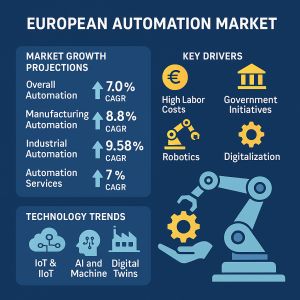
Automation in Europe is expanding across multiple segments, with compound annual growth rates (CAGR) frequently surpassing 8% in core industrial areas.
Overall Automation: The European automation market is projected to grow at a 7.0% CAGR between 2026 and 2033, potentially reaching $160 billion by 2033.
Manufacturing Automation: Expected to expand at a CAGR of around 8.8%–8.9% through 2031, with Germany remaining the continent’s dominant market.
Industrial Automation: Forecast to grow at 8.5%–9.6% CAGR between 2024 and 2032, supported by the increasing adoption of smart factories and connected systems.
Automation Services: The industrial automation services market is predicted to rise at 7% CAGR through 2030.
Marketing Automation: Strong growth is also observed in marketing automation, driven by Europe’s high digital engagement and the use of AI-based personalization tools.
This broad-based expansion highlights Europe’s strategic commitment to automation as both a productivity enabler and a competitive differentiator in the global economy.
Key Growth Drivers
1. High Labor Costs
With Europe facing some of the world’s highest labor costs, automation has become an essential strategy for maintaining competitiveness. Manufacturers are investing heavily in robotic and digital systems to improve efficiency and reduce dependency on manual labor.
2. Government Initiatives
Public policy is playing a central role. Across the EU, national and regional governments are incentivizing Industry 4.0adoption—supporting modernization through funding, tax credits, and technology programs focused on digital transformation and sustainability.
3. Technological Advancements
Robotics: The surge in robot adoption—particularly collaborative robots (cobots)—is revolutionizing manufacturing flexibility and safety.
Digitalization: A growing emphasis on connected and secure production systems is driving the digital transformation of factories.
IoT and IIoT: The Industrial Internet of Things enables real-time data exchange between machines, increasing visibility and control across production lines.
AI and Machine Learning: These technologies are ushering in self-optimizing, predictive automation, enabling systems to learn, adapt, and improve autonomously.
Digital Twins: Companies increasingly use digital twin models to simulate processes, test configurations, and perform predictive maintenance—reducing downtime and accelerating innovation.
4. Operational Efficiency
Automation investments are primarily driven by the pursuit of efficiency and cost optimization. Intelligent control systems, AI analytics, and integrated platforms allow companies to streamline workflows and maximize output with minimal waste.
5. E-commerce and Logistics
The rise of e-commerce has significantly accelerated warehouse and logistics automation, with robotic picking systems, automated guided vehicles (AGVs), and autonomous mobile robots (AMRs) improving speed and accuracy in order fulfillment.
Major Segments and Emerging Trends
Hardware Leadership
In manufacturing automation, hardware remains the largest revenue-generating segment, driven by demand for robots, controllers, and sensors. Continuous innovation in mechatronics and robotics ensures this category will retain its leadership through 2030 and beyond.
Software Integration
Software is the glue connecting automation ecosystems. Growth in Manufacturing Execution Systems (MES), Enterprise Resource Planning (ERP), and AI-based monitoring tools reflects the increasing need for seamless data integration between operational and business layers.
Warehouse Automation
This segment continues to accelerate, propelled by logistics modernization and rising online retail volumes. Automated sorting, packaging, and transportation systems are becoming standard across Europe’s largest distribution centers.
OT/IT Convergence
The merging of Operational Technology (OT) and Information Technology (IT) is transforming industrial architecture. Unified data environments enable end-to-end visibility—from factory floors to enterprise dashboards—paving the way for smarter, autonomous operations.
Conclusion
Europe’s automation market stands at the crossroads of innovation and necessity. With powerful growth drivers—from AI and robotics to digital twins and IoT—automation is evolving from a competitive advantage into a fundamental business requirement.
As industries across the continent embrace smart manufacturing, connected supply chains, and data-driven operations, Europe’s automation ecosystem is poised to define the global standards for efficiency, sustainability, and intelligent design.
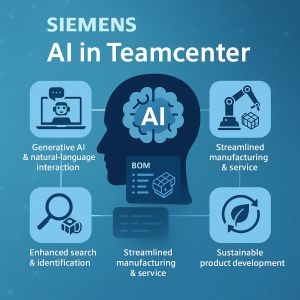
Siemens Digital Industries Software has taken a major step toward intelligent product lifecycle management (PLM) by integrating advanced AI into its Teamcenter platform. The latest Teamcenter 2506 release and the introduction of Teamcenter Copilot bring generative AI, natural-language interaction, and visual intelligence directly into the heart of product development, manufacturing, and service.
Smarter Collaboration with Generative AI
At the center of this update is Teamcenter Copilot, a conversational assistant powered by large language models (LLMs) and securely grounded in a company’s own Teamcenter data.
Conversational Search & BOM Exploration: Users can ask natural-language questions to explore 3D product structures, trace part usage, or filter BOM data.
Document Analysis: The Copilot can summarize large documents, extract requirements, or create tables and bullet lists for faster reviews.
Custom Knowledge Bases: Organizations can build AI knowledge bases tailored to specific products or projects for more relevant responses.
Enhanced Search and Identification
Visual Search: Powered by Azure AI Vision, users can upload a photo to identify similar parts—useful for finding replacements or unknown components.
Natural-Language Search: Instead of complex keyword queries, users can simply ask questions across structured and unstructured Teamcenter data.
These tools make information retrieval faster and more intuitive across teams and disciplines.
Streamlined Manufacturing and Service
AI is also reshaping execution workflows:
AI-Generated Manufacturing Instructions: Upcoming features in Teamcenter Easy Plan will automatically generate and translate work instructions.
Service Planning Automation: AI can create detailed maintenance and service plans by analyzing configurations and past service records, reducing planning time and errors.
Intelligent Data Management and Sustainability
Classification AI: Automatically assigns classes to files, reducing manual effort by up to 90%, while experts validate results through human-in-the-loop review.
AI-Powered Lifecycle Assessment (LCA): Teams can evaluate environmental impact and compliance across a product’s lifecycle—supporting sustainability goals.
Built on Secure, Flexible Architecture
All AI features use a Retrieval-Augmented Generation (RAG) architecture, ensuring answers are based on verified internal data. The platform runs flexibly on major cloud providers like Microsoft Azure or on-premises, protecting IP while enabling scalability.
The Bigger Picture
By embedding AI across its PLM ecosystem, Siemens is transforming Teamcenter from a data repository into an intelligent partner that drives speed, accuracy, and innovation. Engineers, planners, and service teams can now interact naturally with their data, automate repetitive tasks, and make faster, better-informed decisions—paving the way for a new era of digital engineering.