
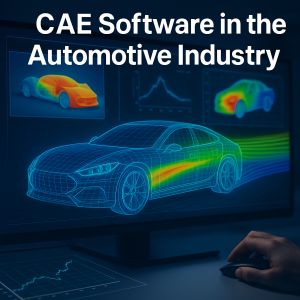
The Rise of Virtual Engineering
In today’s automotive industry, digital simulation has become just as important as physical prototyping. Automakers now rely on computer-aided engineering (CAE) tools to design, test, and validate vehicles before they ever hit the road. These tools let engineers explore everything from crash safety to electric powertrain efficiency — all in a virtual environment that reduces cost and development time.
Major Software Providers and Tools
ANSYS
ANSYS offers a wide range of simulation tools, including:
Autonomous vehicle simulation: Physics-based sensor modeling for lidar, radar, and cameras.
Electric vehicle analysis: Battery, motor, and thermal management simulations.
Fluids and aerodynamics: ANSYS Fluent is widely used for airflow and heat transfer studies.
Dassault Systèmes
Abaqus: Finite element analysis (FEA) software for crash safety, vibration, and thermal studies.
CATIA: CAD/CAE platform with strong surface modeling tools for vehicle design and aerodynamics.
Siemens Digital Industries Software
Simcenter: Virtual testing solutions for autonomous driving, vehicle dynamics, and performance validation using digital twins.
Altair
HyperMesh & HyperWorks: Structural analysis and optimization tools.
MotionSolve: Multi-body dynamics simulations.
Feko: Electromagnetic simulation for antennas and sensors.
From Crash Tests to Comfort
The applications of CAE are as varied as the vehicles they help create. Crash and safety simulations allow engineers to test full vehicle impacts and airbag deployments virtually, saving money on physical prototypes. Structural and durability analyses ensure that components remain reliable over years of use, while NVH (noise, vibration, and harshness) studies fine-tune ride comfort.
Aerodynamics and Efficiency
Aerodynamic modeling remains a critical step in improving fuel efficiency — or range in electric vehicles. By simulating airflow around the body, engineers can optimize vehicle shapes, reduce drag, and improve cooling for key systems such as batteries and power electronics.
The Digital Twin Advantage
System-level simulations are becoming increasingly important as vehicles integrate more electronics and software. Platforms like MATLAB and Simulink allow engineers to virtually test powertrain controls, driver-assistance systems, and AI algorithms for autonomous driving before building prototypes. This integration of hardware and software testing helps manufacturers catch problems earlier and bring innovations to market faster.
Why It Matters
Together, these CAE tools are transforming how vehicles are designed. By combining high-fidelity physics with powerful computing, automakers can innovate quickly, lower costs, and deliver safer, more efficient cars. In an era of electrification and automation, virtual engineering is no longer just a cost-saving measure — it is a competitive necessity.

Hungary’s factory automation market is booming — but there is no single company calling the shots. Instead, global automation giants and local specialists are competing to equip the country’s rapidly expanding manufacturing base, from car plants to battery gigafactories.
A Competitive Landscape
Hungary’s automation scene features a mix of multinational leaders and niche providers:
- Siemens Zrt. – A dominant force, Siemens has supplied PLCs and digitalization solutions for the Mercedes-Benz plant in Kecskemét, where automation upgrades were rolled out in 2024 to support new electric vehicle production.
- ABB Kft. – A strong competitor to Siemens, ABB robots are used in Audi Hungaria’s Győr engine plant, which is one of the largest engine manufacturing facilities in the world.
- Bosch Rexroth Kft. – Drives and control systems from Bosch Rexroth power precision assembly lines across Hungary’s automotive sector, including components for BMW’s new €2 billion plant in Debrecen.
- FANUC Hungary Kft. – Known for its signature yellow robots, FANUC supplies robotic arms for Suzuki’s Esztergom plant, handling welding, painting, and material handling operations.
- Rockwell Automation Inc. – Partnered with several Tier-1 suppliers in Hungary to deploy smart manufacturing systems, helping companies integrate MES (Manufacturing Execution Systems) with ERP systems.
- SMC Industrial Automation – Supplies pneumatic automation components to the food processing sector, including Hungarian beverage producers looking to scale output.
- Schneider Electric – Opened a smart factory in Dunavecse, Hungary, in May 2024, producing circuit breakers and distribution solutions using Industry 4.0 principles, including IoT sensors and real-time data monitoring.
What’s Driving Growth
Hungary is rapidly becoming a manufacturing and logistics hub for Central Europe.
- Automotive Industry – Mercedes-Benz is expanding production at Kecskemét, adding EV models to its line. Audi Hungaria continues to lead engine production for the Volkswagen Group, producing over 1.6 million engines in 2024.
- EV Battery Boom – CATL’s €7.3 billion battery plant in Debrecen is set to be one of Europe’s largest battery production facilities, and BYD has announced plans for its own gigafactory, creating demand for automation systems on a massive scale.
- Collaborative Robots (Cobots) – SMEs are rapidly adopting cobots for welding, packaging, and quality control tasks, lowering automation entry costs for smaller manufacturers.
- Food & Beverage and Logistics – Companies like HELL Energy and MOL’s logistics division are upgrading their facilities with automated conveyors, sorters, and quality inspection systems to boost throughput.
No Clear Market Leader
While Siemens and ABB are leading suppliers for large-scale projects, no single company holds a dominant market share. The Hungarian automation market remains fragmented, giving opportunities for both global and local players to compete on price, technology, and service.
Key Takeaway
Hungary’s factory automation market is growing at double-digit rates, driven by automotive production, EV battery investments, and modernized logistics networks. The race to automate is opening up opportunities for technology providers, system integrators, and engineers with skills in robotics, PLC programming, and Industry 4.0 solutions.
What is CATIA 3DX?
CATIA 3DX is the modern version of CATIA (Computer Aided Three-dimensional Interactive Application), now part of Dassault Systèmes’ 3DEXPERIENCE platform. It’s not just software — it’s a connected, cloud-enabled environment where designers, engineers, and manufacturers can work together on the same product in real time, no matter where they are in the world.
For companies in automotive and aerospace, this means faster innovation, fewer errors, and smoother collaboration between teams.
CATIA V5 vs. CATIA 3DX — The Big Shift
| Feature | CATIA V5 (Traditional) | CATIA 3DX (Modern) |
|---|---|---|
| Where it runs | Installed on a single computer, saving files locally. | Runs on a shared platform — can be cloud-based — so everyone sees the same data. |
| How data is handled | Engineers save separate files, which can get out of sync. | A single, central database keeps everything updated automatically. |
| Teamwork | Teams email files or use shared drives to collaborate. | Teams work on the same model at the same time, even from different continents. |
| Ease of use | A classic but older interface. | Modern, web-like interface that feels more intuitive. |
| Scalability | Requires heavy IT setup and maintenance. | Scales easily for growing teams with subscription-based access. |
In short, CATIA 3DX moves design from a file-based world to a collaborative, connected world.
Real-World Impact in Automotive
In the fast-paced automotive industry, speed and precision are critical. CATIA 3DX helps automakers:
Develop new models faster: Teams can design, test, and refine vehicle components in the same digital space, cutting down prototype costs.
Collaborate across suppliers: Whether a supplier is in Germany, Japan, or the U.S., they can work on the same virtual car in real time, avoiding delays and misunderstandings.
Support electric and autonomous vehicle innovation: CATIA 3DX integrates mechanical, electrical, and software systems, making it easier to design complex EV powertrains and ADAS (advanced driver-assistance systems).
For example, an electric car manufacturer can simulate battery placement, crash performance, and aerodynamics — all virtually — before ever building a physical prototype.
Real-World Impact in Aerospace
In aerospace, safety, complexity, and global collaboration make CATIA 3DX a game-changer. It enables:
Digital twin development: Engineers can create a “virtual twin” of an aircraft, testing everything from aerodynamics to wiring systems digitally before physical production.
Global collaboration: Aerospace programs involve hundreds of suppliers worldwide. CATIA 3DX keeps everyone connected to the same source of truth, preventing costly rework.
Regulatory compliance: The platform tracks design history and changes automatically, making audits and certification easier.
Imagine designing a new jetliner: thousands of parts, miles of wiring, and strict safety requirements. CATIA 3DX helps keep all that complexity organized, ensuring the final aircraft is safe and built right the first time.
Why It Matters
CATIA 3DX isn’t just for engineers — it connects the entire product lifecycle: from concept sketches to factory floor planning. The result is:
Faster time to market
Fewer mistakes and rework
Better collaboration between designers, suppliers, and manufacturers
Reduced costs thanks to virtual testing and fewer physical prototypes
For industries like automotive and aerospace, where innovation cycles are getting shorter and competition is fierce, CATIA 3DX provides a significant competitive advantage.
BMW Bets Big on Neue Klasse to Outpace EV Rivals

At BMW’s headquarters in Munich, history and future sit side by side. In the company museum, visitors marvel at classics like Elvis Presley’s 507 convertible, famously repainted red after fans covered it in lipstick. Just across the way, behind closed doors, engineers are working on a very different kind of icon — a camouflaged SUV that BMW believes will define its next era: the iX3.
This electric SUV is the launch vehicle for Neue Klasse, BMW’s most ambitious project in more than a century. CEO Oliver Zipse calls it “the biggest single investment into one architecture we’ve ever done,” and for good reason. Neue Klasse isn’t just a model line, but a complete overhaul of BMW’s technology, design, and production strategy.
The iX3 sets the tone. With up to 800 km of range and 400 kW fast charging, it aims to leapfrog Tesla’s Model Y and take on fast-rising Chinese challengers. Reviewers who tested prototypes in southern France praised its driving dynamics, calling it smoother than BMW’s current EVs and even rivaling Rolls-Royce for refinement in traffic. Importantly, BMW engineers have worked hard to ensure the iX3 still feels like an “Ultimate Driving Machine,” speeding up the responsiveness of brakes, steering, and regenerative systems.
Beneath the hood — or rather, behind the screens — lies an equally significant shift. Neue Klasse vehicles will be powered by four central “superbrains,” computers with 20 times the power of BMW’s existing setup. These will unify infotainment, driver assistance, and core vehicle functions, making the cars more connected and easier to update over time. To support this, BMW has built a global software network, employing 5,000 specialists across six countries.
The rollout comes at a pivotal time. Tesla, once the benchmark, faces regulatory uncertainty in the U.S. and brand fatigue in Europe. Meanwhile, Chinese automakers like BYD and Xiaomi are flooding the market with affordable EVs, leaving global giants scrambling to keep up. BMW, still reliant on combustion sales for much of its profit, sees Neue Klasse as the bridge to a fully electric future. By 2027, its Munich factory will exclusively produce EVs, closing a 75-year chapter of gasoline-powered history.
Challenges remain. BMW’s sales in China have been slipping, and local competitors offer strong products at lower prices. Zipse insists decoupling from China isn’t an option, calling it a hub of innovation and scale. To stay relevant, BMW has tailored features for the market, from integrating WeChat to debuting AI-powered assistants in partnership with local startups.
For Zipse, who steps down as CEO next year, Neue Klasse is a defining gamble — one that could secure BMW’s place in the electric age or expose it to the same pressures eroding rivals. “What’s much more important is the question: are the products attractive?” he says. With the iX3 leading the charge, BMW is betting the answer will be yes.