Germany’s automotive industry is entering what many analysts describe as a “make-or-break” period, as deep structural problems collide with an uncertain economic outlook and an uneven transition to electric mobility. Once the undisputed backbone of Europe’s industrial economy, the sector is now grappling with falling profits, aggressive global competition, and mounting pressure to reinvent itself for an electric, software-driven future.
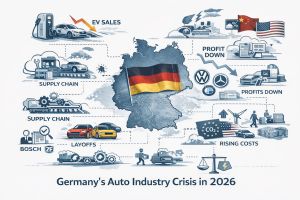
At the heart of the crisis lies the difficult shift to electric vehicles (EVs). German manufacturers have poured tens of billions of euros into electrification, yet demand has failed to grow as quickly or as sustainably as expected. While EV sales recovered in 2025, much of that rebound reflected a correction after earlier subsidy cuts rather than a genuine surge in consumer appetite. Compared with rivals, German firms continue to lag in software development, charging infrastructure integration, and clear long-term EV strategies.
The financial strain is becoming increasingly visible. Industry heavyweights including Volkswagen, BMW, and Mercedes-Benz have all reported sharp declines in profitability. The situation has been particularly severe at Porsche, where profits plunged by roughly 95 percent, underscoring how even premium brands are struggling to shield themselves from market headwinds.
Competition is intensifying on multiple fronts. Chinese manufacturers are rapidly expanding their market share, both domestically in China and increasingly across global markets, benefiting from scale, lower costs, and strong state backing. At the same time, the prospect of higher U.S. tariffs on imported vehicles adds another layer of uncertainty for German exporters already under pressure.
The pain is spreading through the supply chain. Major suppliers are cutting jobs as they restructure for a future with fewer combustion-engine components. Bosch and ZF alone have announced the elimination of thousands of positions, highlighting the social and economic consequences of the industry’s transformation.
Yet the picture is not uniformly bleak. Recent production data has surprised to the upside. In November 2025, German industrial output rose unexpectedly, driven largely by a jump in car manufacturing. This ended a multi-month streak of declines and offered a rare positive signal in an otherwise fragile environment. Even so, overall vehicle sales remain well below their 2017 peak, reinforcing the sense that the recovery is incomplete.
Looking ahead to 2026, the challenges remain formidable. A true, self-sustaining recovery in the EV market has yet to materialize. Tighter EU emissions regulations will raise compliance costs, while continued advances by Chinese competitors threaten German firms’ traditional strongholds. Domestically, high living costs and elevated electricity prices risk further dampening consumer spending on big-ticket items like cars.
Recent strategic decisions reflect the pressure to adapt. Volkswagen’s decision to close its joint-venture plant in Nanjing with SAIC Motor underscores the difficulties German manufacturers face even in markets that once fueled their growth.
In essence, Germany’s auto industry stands at a crossroads. The sector remains a cornerstone of the national economy, but its future competitiveness will depend on decisive strategic shifts—particularly in electrification, software, and cost structures. Whether 2026 becomes a turning point or a further step in relative decline will hinge on how effectively the industry navigates this historic transition.